

AI compute is becoming an infrastructure asset class as crypto capital keeps flowing
NVIDIA, OpenAI, Anthropic, and Lambda pushed the AI capital cycle deeper into custom silicon and structured financing, while crypto ETF demand remained strong even as BTC and ETH paused.
Top Stories
1. NVIDIA’s numbers got bigger, and so did its ecosystem strategy
What happened: NVIDIA reported Q2 FY2027 revenue of $96.2B, up 106% YoY, with Data Center revenue of $89.0B, up 117%. Today it also invested $3.5B in MediaTek convertible bonds as MediaTek adopted NVLink Fusion for custom AI silicon.
Why it matters: NVIDIA increasingly captures value beyond the GPU itself by making its interconnect and rack architecture the platform around custom accelerators.
What to watch: Whether custom XPUs expand NVIDIA’s addressable market or eventually displace some GPU workloads.
Number + source: $108B Q3 revenue guidance. NVIDIA.
2. OpenAI proves its first inference chip works
What happened: OpenAI released initial Jalapeño results showing 1.5–1.9× more AI work per watt and 1.7–3.6× lower end-to-end latency across GPT-OSS, DeepSeek R1 and Kimi K2.5 comparison workloads. Deployment inside OpenAI is planned by year-end.
Why it matters: Inference is becoming a recurring cost center. Owning silicon gives frontier labs another lever over margins, latency and dependence on merchant GPUs.
What to watch: Production-scale economics versus NVIDIA Rubin/Blackwell systems.
Number + source: Jalapeño sustained ≤550W in tested workloads despite a 700W rating. OpenAI.
3. Anthropic’s compute bill starts looking like infrastructure finance
What happened: Reuters reported Anthropic plans to rent $45B of Nscale compute over six years from a 460MW West Virginia deployment using NVIDIA Vera Rubin. Anthropic is also reportedly preparing to publish its IPO prospectus shortly after Labor Day.
Why it matters: Frontier-model economics are increasingly tied to enormous long-term infrastructure commitments.
What to watch: The IPO filing could provide one of the clearest public looks yet at frontier-lab revenue, compute costs and capital intensity.
Number + source: $45B / 6 years / 460MW. Reuters.
4. ETF money kept coming even as crypto prices stalled
What happened: U.S. spot Bitcoin ETFs took in $924.5M during Aug. 24–28, while ETH ETFs took in $815.7M. BTC finished Sunday almost unchanged WoW and ETH fell about 1.9%.
Why it matters: Institutional demand remained positive even after the prior week’s huge price move.
What to watch: Whether ETF inflows begin translating into stronger spot-price response again.
Number + source: BTC ETF inflows fell 51.8% WoW; ETH ETF inflows rose 17.8%. Farside.
5. Lambda brings investment-grade debt deeper into the neocloud market
What happened: Lambda closed a $926M senior secured term loan B financing GPU infrastructure for a committed investment-grade customer. Moody’s rated the facility Baa2.
Why it matters: Contracted GPU capacity is increasingly being financed like infrastructure rather than speculative venture technology.
What to watch: Customer concentration, hardware depreciation and whether this financing model spreads across neoclouds.
The Board
Capital continued moving into both themes, but public-market performance became more selective. Crypto funds absorbed fresh capital without producing another explosive spot move. AI demand indicators remained exceptional, yet an equal-weight public neocloud basket fell roughly 5% for the week. Investors are starting to separate demand growth from durable economic capture.
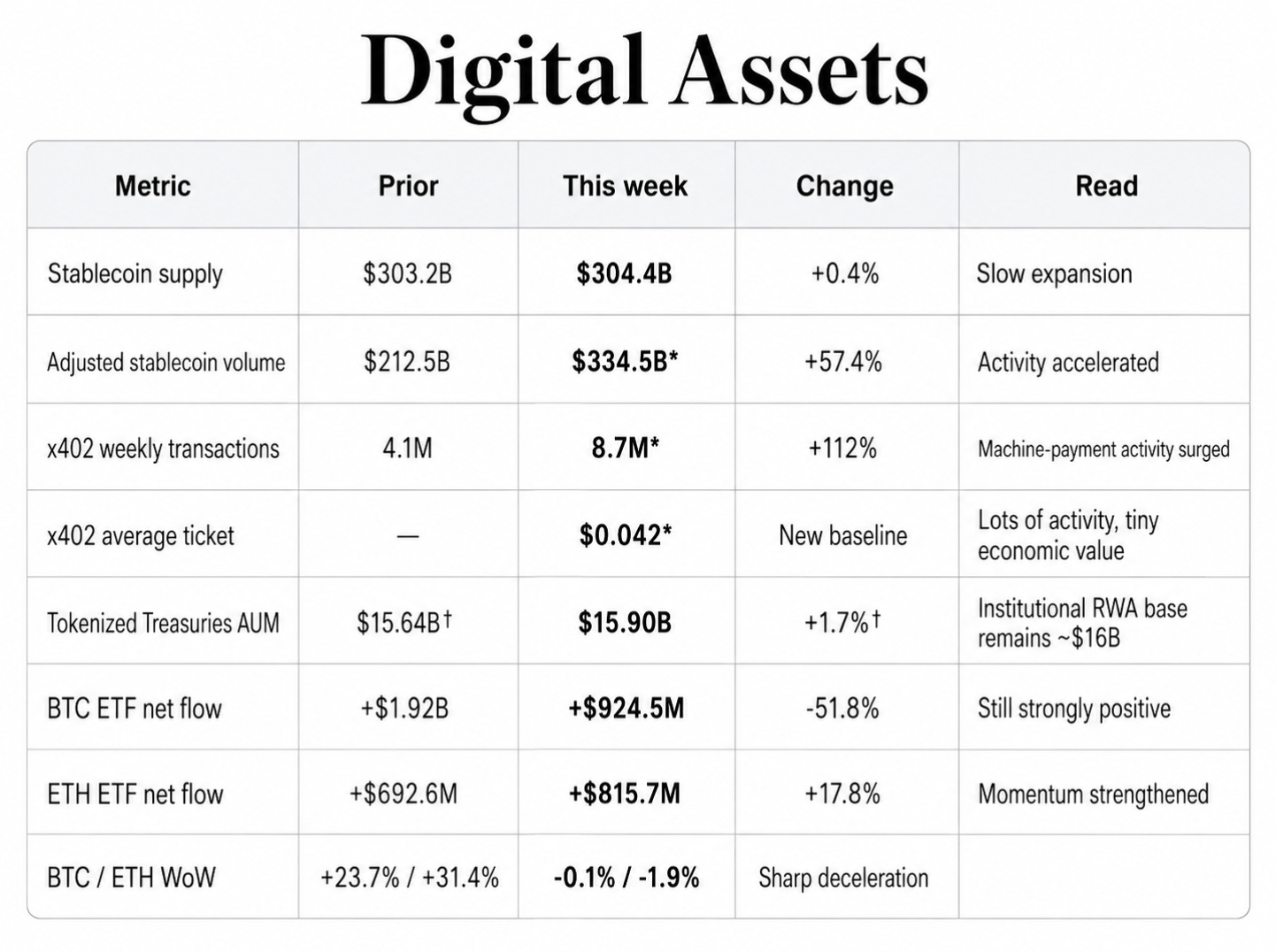
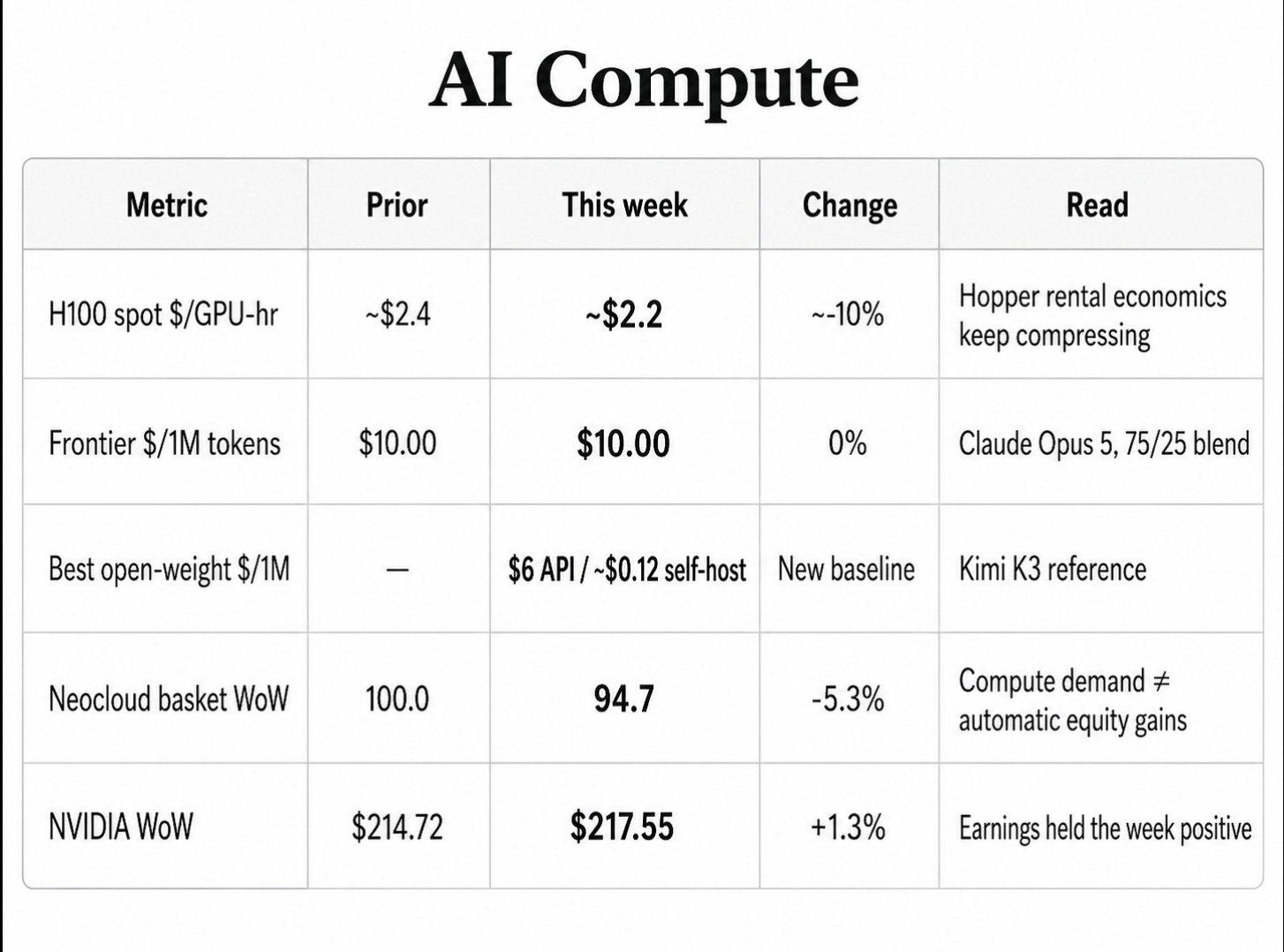
H100 note: pricing is an average of comparable public marketplace/preemptible rates rather than the cheapest listing. Lambda remains a private-company pricing reference and is excluded from the equity basket.
The one thing the board said: Demand is no longer the main question. Who captures the economics, and how that growth gets financed, is becoming the question.
What We Published
Correction: [None / add if needed]
Episode / video: [Title + views + watch time + retention]
Newsletter / post: [Title + opens + clicks + subscriber change]
Clip that travelled: [Clip + reach + shares]
Term of the Week
Inference ASIC
Definition: A chip designed specifically to serve already-trained AI models.
Why it matters: Inference becomes a huge recurring expense as AI usage scales.
The trap: Strong results on selected models do not mean general-purpose GPUs are obsolete.
Where it appeared: OpenAI’s Jalapeño announcement.
Week Ahead
DateEventWhy it mattersNumber to watchSep. 1U.S. JOLTSLabor strength feeds directly into Fed expectations7.36M prior openingsSep. 2Broadcom Q3 earningsMajor read on custom AI accelerators and networking$16B AI semiconductor revenue guideSep. 4August U.S. jobs reportCould reset rates and risk-asset positioning~58K payrolls / 4.1% unemployment
The Takeaway
One takeaway: AI compute is evolving from a chip trade into a vertically integrated infrastructure and financing stack. Crypto is moving in a similar institutional direction, although this week showed that capital inflows alone are not enough to guarantee immediate price appreciation.